
- Scenario four – analysing the ABG results
Look at the patient’s ABG results again (select Essentials to review the results). Identify which of these statements apply to your patient.
Select the correct statements and then choose Confirm.
Feedback
That is not quite right. Have another go.
Feedback
That is not quite right.
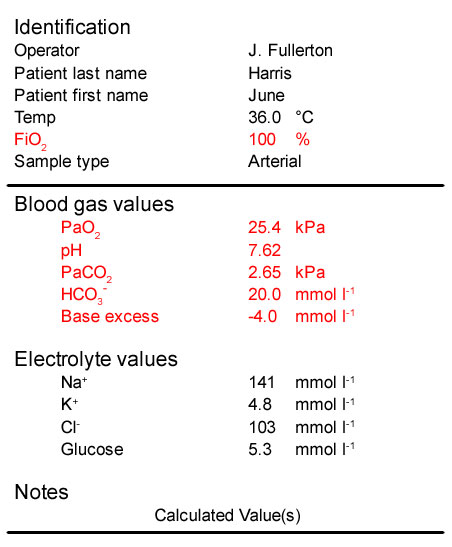
- The patient is not hypoxaemic as her PaO2 is >10 kPa. However we would expect a higher PaO[sub]2[/sub] being ventilated with 100% oxygen, indicating impaired oxygenation
- The patient has an alkalaemia as her pH is >7.45
- The patient’s PaCO[sub]2[/sub] is very low and is consistent with her pH being increased and she has a respiratory alkalosis
- Her bicarbonate and base excess are both slightly low suggesting a mild metabolic acidosis, consistent with the brief cardiac arrest and impaired circulation resulting in lactic acid production
In summary:
A respiratory alkalosis, mild metabolic acidosis and impaired oxygenation. Treatment will include:
Treatment will include:
- Reduce the FiO[sub]2[/sub], aim for PaO[sub]2[/sub] 12-15 kPa
- Reduce the minute volume; set a tidal volume of 500 ml and rate of 10-12 breaths min-1
- Further adjustments can be made depending on the results of repeat ABGs.
Feedback
That is not right. Have another go.
Feedback
That is not right.
- The patient is not hypoxaemic as her PaO2 is >10 kPa. However we would expect a higher PaO[sub]2[/sub] being ventilated with 100% oxygen, indicating impaired oxygenation
- The patient has an alkalaemia as her pH is >7.45
- The patient’s PaCO[sub]2[/sub] is very low and is consistent with her pH being increased and she has a respiratory alkalosis
- Her bicarbonate and base excess are both slightly low suggesting a mild metabolic acidosis, consistent with the brief cardiac arrest and impaired circulation resulting in lactic acid production
In summary:
A respiratory alkalosis, mild metabolic acidosis and impaired oxygenation. Treatment will include:
- Reduce the FiO[sub]2[/sub], aim for PaO[sub]2[/sub] 12-15 kPa
- Reduce the minute volume; set a tidal volume of 500 ml and rate of 10-12 breaths min-1
- Further adjustments can be made depending on the results of repeat ABGs.
Feedback
That is right.
- The patient is not hypoxaemic as her PaO2 is >10 kPa. However we would expect a higher PaO[sub]2[/sub] being ventilated with 100% oxygen, indicating impaired oxygenation
- The patient has an alkalaemia as her pH is >7.45
- The patient’s PaCO[sub]2[/sub] is very low and is consistent with her pH being increased and she has a respiratory alkalosis
- Her bicarbonate and base excess are both slightly low suggesting a mild metabolic acidosis, consistent with the brief cardiac arrest and impaired circulation resulting in lactic acid production
In summary:
A respiratory alkalosis, mild metabolic acidosis and impaired oxygenation. Treatment will include:
- Reduce the FiO[sub]2[/sub], aim for PaO[sub]2[/sub] 12-15 kPa
- Reduce the minute volume; set a tidal volume of 500 ml and rate of 10-12 breaths min-1
- Further adjustments can be made depending on the results of repeat ABGs.
References
See chapter 15 of the ALS manual for further reading about arterial blood gas analysis.
Essentials: 5-step approach to ABG interpretation
Step 1 – how is the patient?
Step 2 – is the patient hypoxaemic?
Step 3 – is the patient acidaemic or alkalaemic?
Step 4 – what happened to the PaCO2?
Step 5 – what has happened to the base excess or bicarbonate?
Normal values
PaO[sub]2[/sub] > 10 kPa (75 mmHg) on air
pH 7.35 – 7.45
PaCO[sub]2[/sub] 4.7 – 6.0 kPa
HCO[sub]3[/sub] 22 – 26 mmol l-1
BE +/- 2 mmol l[sup]-1[/sup]
Step 2 – is the patient hypoxaemic?
Step 3 – is the patient acidaemic or alkalaemic?
Step 4 – what happened to the PaCO2?
Step 5 – what has happened to the base excess or bicarbonate?
Normal values
PaO[sub]2[/sub] > 10 kPa (75 mmHg) on air
pH 7.35 – 7.45
PaCO[sub]2[/sub] 4.7 – 6.0 kPa
HCO[sub]3[/sub] 22 – 26 mmol l-1
BE +/- 2 mmol l[sup]-1[/sup]
Settings
Font colour
default inverted high contrast high contrast inverted high contrast soft green on blackSample text
text looks like thisTEXT LOOKS LIKE THIS
